
This function returns the modified Bessel function of the first kind, Iₙ(x), which corresponds to the Bessel function Jₙ evaluated for purely imaginary arguments.
Syntax
BESSELI(x ; n)
Arguments
- x (required)
The value at which to evaluate the function:- Must be a real number
- Valid range: approximately ±700 (varies with order n)
- n (required)
The order of the Bessel function:- Must be a positive integer
- Non-integer values are truncated (not rounded)
Background
Iₙ(x), like Kₙ(x), belongs to the modified Bessel functions that exhibit exponential growth or decay, unlike the oscillatory behavior of standard Bessel functions Jₙ(x) and Yₙ(x). Iₙ(x) is the solution to the modified Bessel’s differential equation:
x²y » + xy’ – (x² + n²)y = 0
or
y » + (1/x)y’ – (1 + n²/x²)y = 0
The modified Bessel function of the first kind can be represented as a loop integral of order n. For real ν, it can be calculated using:
I_ν(x) = (1/π) ∫[0 to π] e^{x cosθ}cos(νθ) dθ
where Γ(y) is the gamma function.
Example
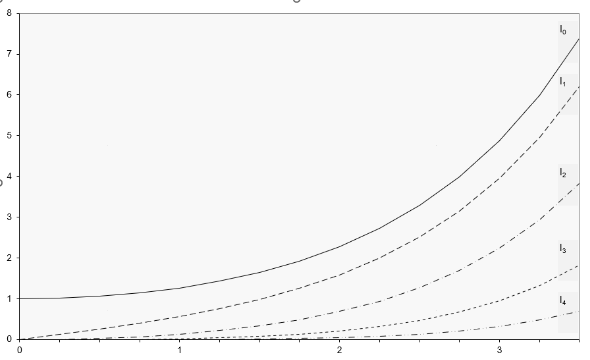
Working with Bessel functions requires specialized domain knowledge. This example focuses on mathematical properties and their graphical representation (see Figure below).
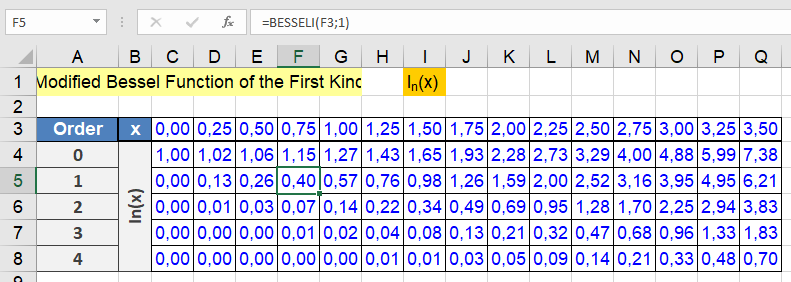
Implementation notes:
- Cell A3 contains the reference label « Order »
- Cells C4:Q8 contain BESSELI() formulas
- Row 3 contains x-values (first argument)
- Column A contains order values (second argument)
- Example formula in C4:
=BESSELI(C$3,$A4)
The data range C3:Q8 generates the graph in Figure below, showing the characteristic exponential growth of Iₙ(x), which produces large values even at small x.
Key Properties
- Exhibits monotonic exponential growth
- Iₙ(0) = 0 for n > 0
- Iₙ(-x) = (-1)ⁿIₙ(x)
- Recurrence relations connect functions of different orders
Technical Applications
- Electromagnetic wave propagation
- Heat conduction in cylindrical systems
- Quantum mechanical potential problems
- Fluid dynamics in porous media