
Its converts a decimal number to its hexadecimal (base-16) equivalent using two’s complement notation.
Syntax
DEC2HEX(number; [places])
Arguments
- number (required)
- Decimal integer to convert (range: -549,755,813,888 to +549,755,813,887)
- Non-integers are truncated (decimal places ignored)
- Negative values return 10-digit two’s complement hexadecimal
- places (optional)
- Minimum number of hexadecimal digits to display
- Adds leading zeros for positive numbers
- Has no effect on negative numbers (always 10 digits)
- Decimal places are truncated if specified
Technical Background
The conversion uses two’s complement representation for negative values. For complete number system theory, see the « Number Systems » introduction section.
Examples
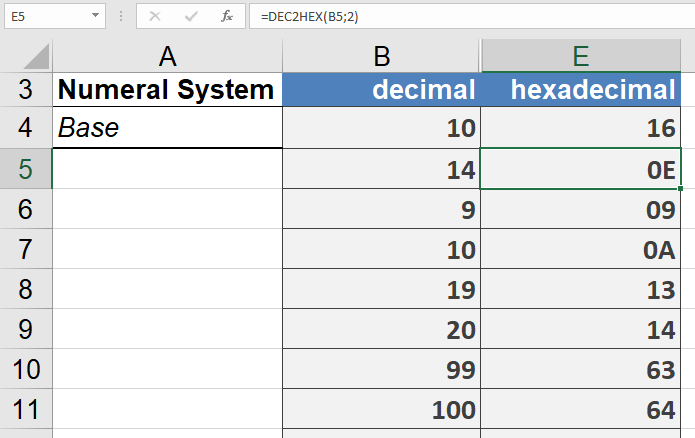
=DEC2HEX(14) // Returns « 0E »
Key Specifications
- Input Range: -549,755,813,888 to 549,755,813,887
- Output Characteristics:
- Positive: Variable length (1-10 hex digits)
- Negative: Always 10 hex digits
- Letter digits (A-F) appear in uppercase
- Special Handling:
- Negative numbers ignore places parameter
- Fractional values are truncated
Common Applications
- Memory address representation
- Color code manipulation
- Cryptographic operations
- Low-level system programming
Error Conditions
- Returns #NUM! error when:
- Number < -549,755,813,888
- Number > 549,755,813,887
- Places < required digits for positive numbers
- Returns #VALUE! for non-numeric inputs