
This function returns the minimum number of successes (k) in a binomial distribution where the cumulative probability is ≥ a specified threshold (alpha). It is the inverse of BINOM.DIST().
Syntax
BINOM.INV(trials; probability_s; alpha)
Key Use Case:
- Quality Control: Determine the maximum allowable defective items in a batch before rejecting it.
- Decision-Making: Find critical thresholds for pass/fail scenarios (e.g., survey results, manufacturing tolerances).
Arguments
| Argument | Required? | Description |
| trials | Yes | Total number of independent trials (e.g., 100 surveys). |
| probability_s | Yes | Probability of success per trial (e.g., 0.5 for 50%). |
| alpha | Yes | Target cumulative probability threshold (e.g., 0.95 for 95% confidence). |
Background
- Inverse Binomial Distribution:
- Solves for k in:
P(X≤k)≥αP(X≤k)≥α
-
- Where:
- P = Cumulative binomial probability.
- k = Maximum successes allowed before exceeding the threshold.
- Where:
- Assumptions:
- Trials are independent (e.g., coin flips, quality checks).
- Only two outcomes per trial (success/failure).
- Relation to BINOM.DIST():
- If BINOM.DIST(k, n, p, TRUE) = alpha, then BINOM.INV(n, p, alpha) = k.
Example: Vacation Survey
Scenario:
- You ask 100 people for directions, each with a 50% chance (p = 0.5) of answering « yes. »
- Question: What is the maximum number of « yes » responses (k) where the cumulative probability ≤ 0.1% (alpha = 0.001)?
Formula:
BINOM.INV(100, 0.5, 0.001)
Result: 35 (see Figure below).
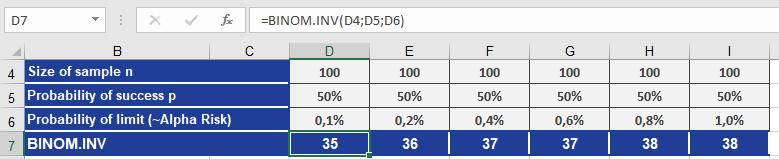
Interpretation:
- There is a 0.1% chance that 35 or fewer people would say « yes » by random chance.
- If you observe >35 « yes » answers, the result is statistically significant (exceeds the threshold).
Key Notes
- Quality Control Application:
- If a batch of 1,000 parts has a 2% defect rate (p = 0.02), use BINOM.INV() to find the maximum defects allowed before rejecting the batch (e.g., for alpha = 0.95).
- Threshold Logic:
- Lower alpha = Stricter criteria (fewer allowed successes).
- Higher alpha = More lenient criteria (more allowed successes).
- Limitations:
- For large trials (e.g., >1,000), consider approximations like the Normal distribution.