
This function returns the Bessel function of the second kind, Yₙ(x), also known as the Weber function or Neumann function.
Syntax
BESSELY(x; n)
Arguments
- x (required)
The value at which to evaluate the function:- Must be a positive real number
- Valid range: 0 < x ≤ ~1.34×10⁸ (upper limit varies slightly with order n)
- n (required)
The order of the Bessel function:- Must be positive
- Maximum value depends on x (covers all practical applications)
- Non-integer values are truncated (decimal places ignored)
Background
Yₙ(x) is a solution to Bessel’s differential equation:
x²y » + xy’ + (x² – n²)y = 0
or
y » + (1/x)y’ + (1 – n²/x²)y = 0
It can be expressed in terms of Jₙ(x):

Example
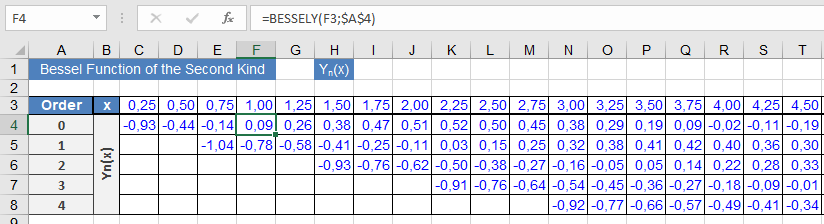
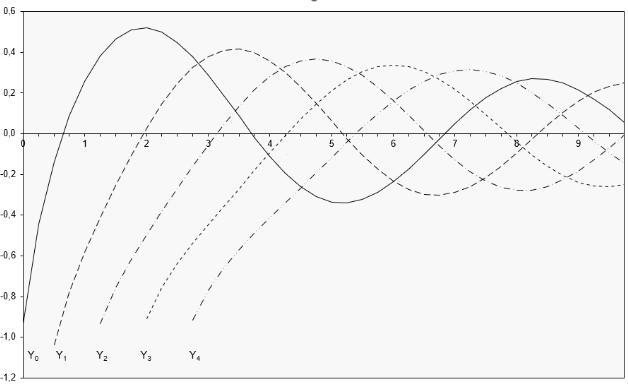
The graphical representation demonstrates Yₙ(x) behavior (see Figures below):
Implementation notes:
- Worksheet calculates Yₙ(x) for orders n=0 to 4
- Higher orders omitted from graph due to large initial values
- Characteristic oscillatory behavior with singularities visible in Figure above
Key Properties
- Oscillates with decreasing amplitude as x increases
- Singular at x=0 for all orders
- Yₙ(x) and Jₙ(x) are linearly independent solutions
- Satisfies the same recurrence relations as Jₙ(x)
Technical Applications
- Solutions to wave equations in cylindrical coordinates
- Modeling of acoustic waveguides
- Electromagnetic field problems
- Heat transfer in circular geometries
Computation Notes
- Calculated via relation to Jₙ(x) functions
- Requires special handling near x=0 due to singularity
- Higher orders show more rapid oscillations