
This function calculates probabilities for a binomial distribution, which models scenarios with:
- A fixed number of trials (trials).
- Only two outcomes per trial: success or failure.
- Independent trials with a constant success probability (probability_s).
Syntax
BINOM.DIST(number_s; trials; probability_s; cumulative)
Example Use Case:
- Calculating the probability that 50 out of 100 people support a smoking ban, given each has a 60% chance of supporting it.
Arguments
| Argument | Required? | Description |
| number_s | Yes | Number of successful trials (e.g., 50 « yes » responses). |
| trials | Yes | Total number of trials (e.g., 100 surveys). |
| probability_s | Yes | Probability of success per trial (e.g., 0.6 for 60%). |
| cumulative | Yes | TRUE = Cumulative probability (≤ number_s successes). FALSE = Exact probability (exactly number_s successes). |
Background
- Binomial Distribution Basics:
- Models counts of successes in n independent Bernoulli trials (e.g., coin flips, survey responses).
- Probability Mass Function (PMF):

-
-
- (nk)(kn) = Combination of n trials with k successes (COMBIN(n, k) in Excel).
- p = Success probability per trial.
-
- Key Properties:
- Mean (Expected Value): μ=n×pμ=n×p
- Variance: σ2=n×p×(1−p)σ2=n×p×(1−p)
- Bernoulli Process:
- Named after mathematician Jakob Bernoulli.
- Each trial is independent with outcomes 1 (success) or 0 (failure).
Examples
- Vacation Directions (Yes/No Survey)
Problem:
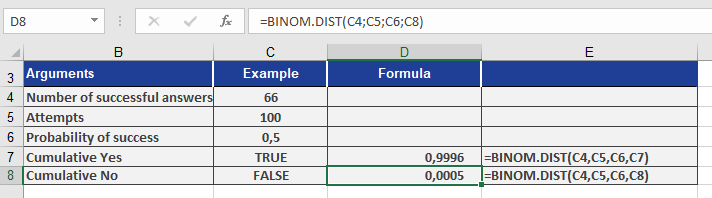
- You ask 100 strangers for directions, with a 50% chance (p = 0.5) each says « yes. »
- What’s the probability that exactly 66 answer « yes »?
Formula:
BINOM.DIST(66; 100; 0.5; FALSE) // Exact probability
Result: 0.05% (see Figure below).
Cumulative Probability (≤66 yes answers):
BINOM.DIST(66, 100, 0.5, TRUE) // Returns ~100%
- Damaged Packages (Quality Control)
Problem:
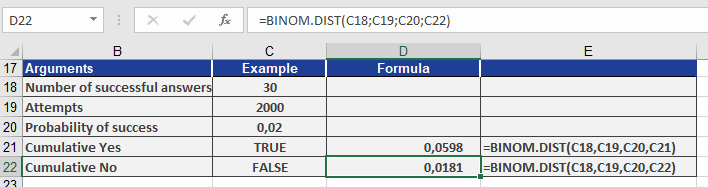
- A factory produces 2,000 packages, with a 2% defect rate (p = 0.02).
- What’s the probability that exactly 30 are damaged?
Formula:
BINOM.DIST(30; 2000; 0.02; FALSE) // Exact probability
Result: 1.8% (see Figure below).
Cumulative Probability (≤30 damaged):
BINOM.DIST(30; 2000; 0.02; TRUE) // Returns 6%
Key Notes
- When to Use:
- FALSE: For exact counts (e.g., « What’s the chance of exactly 3 wins in 5 games? »).
- TRUE: For thresholds (e.g., « What’s the chance of ≤3 wins? »).
- Assumptions:
- Trials must be independent (e.g., survey responses don’t influence each other).
- probability_s must stay constant across trials.
- Limitations:
- For large trials (e.g., >1000), consider approximations like the Poisson or Normal distribution.