
This function calculates the discount rate (anticipative interest rate) for a security based on its cash value, redemption value, and time to maturity (simple interest yield).
Syntax
DISC(Settlement; Maturity; Price; Repayment; [Basis])
Arguments
- Settlement (required)
The date when the security is purchased.- Must be a valid date; time values are truncated.
- Maturity (required)
The date when the security matures (redemption date).- Must be a valid date; time values are truncated.
- Price (required)
The purchase price per $100 face value of the security.- Must be a positive number.
- Repayment (required)
The redemption value per $100 face value at maturity.- Must be a positive number.
- Basis (optional)
The day-count convention used for interest calculation.- If omitted, defaults to 0 (US (NASD) 30/360).
Error Handling
- If invalid dates or non-numeric values are provided, #VALUE! is returned.
- If invalid numbers (e.g., negative prices) are entered, #NUMBER! is returned.
Background
The anticipative interest method calculates yield upfront (discounting from the future value), unlike traditional interest calculations (yield in arrears).
- Common in short-term securities (e.g., treasury bills, commercial paper).
- The formula for the discount rate is derived from:
Discount Rate=Repayment−PriceRepayment×Days in YearDays to MaturityDiscount Rate=RepaymentRepayment−Price×Days to MaturityDays in Year

- Relationship to RECEIVED():
DISC() and RECEIVED() are inverse functions, allowing conversion between anticipative and arrears interest rates.
Examples
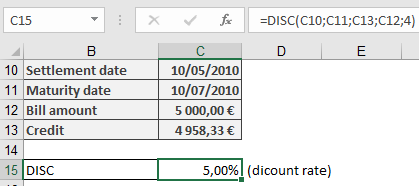
- Bill of Exchange Discounting
- Scenario: A $5,000 bill of exchange with 2 months to maturity is discounted at $4,958.33.
- Formula:
=DISC(« 10-May-2010 », « 10-Jul-2010 », 4958.33, 5000, 4)
-
- Result: 5% discount rate.
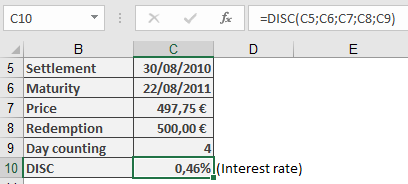
- Treasury Bond Yield
- Scenario: A German treasury bond (face value €500) priced at €497.75 with 1-year maturity.
- Formula:
=DISC(« 30-Aug-2010 », « 22-Aug-2011 », 497.75, 500, 4)
-
- Result: 0.46% annual discount rate.
Notes
- For tax or regulatory compliance, verify day-count conventions (Basis).
- Use YIELDDISC() or RECEIVED() for equivalent yield calculations.