
This function calculates probabilities for an exponentially distributed random variable, modeling the time between independent events. It is commonly used to predict waiting times, such as:
- The time until a call center receives the next call.
- The duration between ATM transactions.
Syntax
EXPON.DIST(x ; lambda ; cumulative)
Arguments
- x (required): The time value for which you want to calculate the probability.
- lambda (required): The rate parameter (average events per time unit).
- Example: If calls average 3 per minute, lambda = 3.
- cumulative (required):
- TRUE: Returns the cumulative distribution function (CDF) (probability of an event occurring by time x).
- FALSE: Returns the probability density function (PDF) (likelihood of an event occurring at exactly time x).
Background
Key Properties
- Memoryless Process: The probability of an event occurring in the next interval is independent of past events.
- Decay/Growth: Models processes where values change by a constant factor over equal intervals (e.g., radioactive decay, call arrivals).
- Inverse: The natural logarithm is the inverse of the exponential function (base *e*, Euler’s number ≈ 2.71828).
Formulas
- Probability Density Function (PDF):
f(x;λ)=λe−λx(Likelihood at exact time x)
- Cumulative Distribution Function (CDF):
F(x;λ)=1−e−λx(Probability of event occurring by time x)
Example
Let’s use with the example of the call center. Assume that you operate a call center for a printer manufacturer. The call center is open 24 hours a day, seven days a week. You want to analyze the call pattern and count the incoming calls every hour over one day. This means that the time interval is 60 minutes.
The recorded calls result in the statistics shown in Figure below.
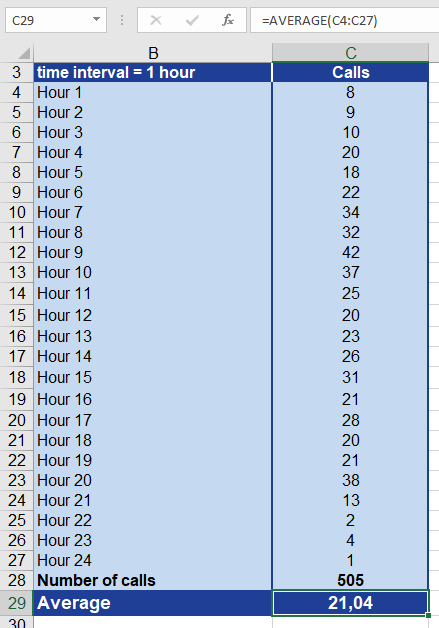
After you have calculated the average of all incoming calls, you can make the following statements:
Every hour, an average of 21 calls come in.
This means that, on average, every three minutes a customer calls.
Now you want to know the probability that a customer will call after two minutes. To find out, you use the EXPON.DIST() function. What information do you have to enter for the arguments?
x = 2, because we want to calculate the probability for a call after 2 minutes.
Lambda = 3, because this is the mean value of events per interval and therefore the passed value.
cumulative = TRUE, because in our example the cumulative distribution should be returned.
Figure below shows the result from the calculation of the probability with the EXPON.DIST() function.
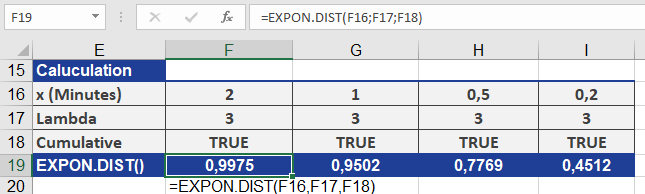
The probability for a call coming in after two minutes is 99 percent.
As you can see in figure above, the probability decreases as the time interval decreases. This means that the probability for a call to come in after
0.2 minutes (12 seconds) is only 45 percent.
Key Notes
- Lambda (λλ): Must match the time unit of x (e.g., if x is in minutes, lambda = events/minute).
- Common Uses:
- Reliability analysis (e.g., time until failure).
- Queueing theory (e.g., wait times).
- Visualization: Exponential distributions have a steep decay curve.