
This function returns the probabilities of a gamma-distributed random variable. It is used to analyze variables with a skewed distribution, commonly applied in queuing theory and other statistical analyses.
Syntax
GAMMA.DIST(x; alpha; beta; cumulative)
Arguments
- x (required) – The value (quantile) for which the probability is calculated.
- alpha (required) – A shape parameter of the distribution.
- beta (required) – A scale parameter of the distribution. If beta = 1, the function returns the standard gamma distribution.
- cumulative (required) – A logical value determining the function type:
- If TRUE, GAMMA.DIST() returns the cumulative distribution function (probability that a random event occurs between 0 and x).
- If FALSE, it returns the probability density function.
Background
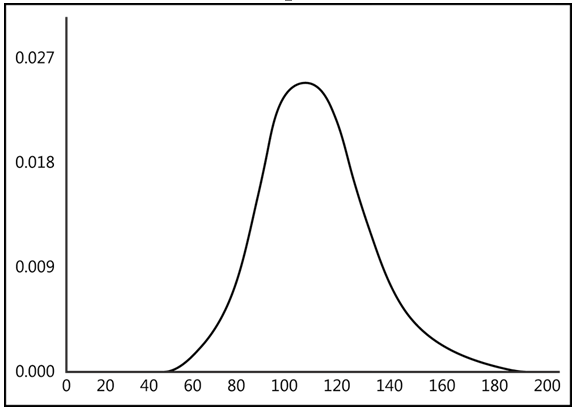
The gamma distribution is a continuous probability distribution for positive real numbers (see Figure below). Its probability density function is defined for x > 0, with f(x) = 0 for other values.
Key Properties:
- Parameters p (alpha) and q (beta) must be > 0.
- The prefactor bᵖ/Γ(p) ensures correct normalization, where Γ(p) is the gamma function.
- Expected value (mean) = αβ
- Variance = αβ²
Reproductive Property:
- If X and Y are independent gamma-distributed variables with parameters (β, pₓ) and (β, pᵧ), their sum X + Y follows a gamma distribution with parameters (β, pₓ + pᵧ).
Special Cases:
- The chi-square distribution (with k degrees of freedom) is a gamma distribution where p = k/2, β = ½.
- The exponential distribution (with rate λ) is a gamma distribution with p = 1, β = λ.
- The Erlang distribution (with λ and n degrees of freedom) corresponds to p = n, β = λ.
- The quotient X/(X + Y) of two independent gamma-distributed variables follows a beta distribution with parameters pₓ and pᵧ.
Parameterization Note:
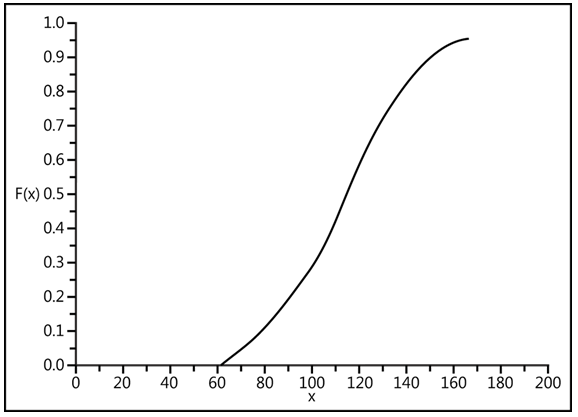
- Some literature uses alternative parameterizations (e.g., αβ for mean). To avoid confusion, explicitly state moments (e.g., mean = αβ, variance = αβ²). See Figure below.
Function Details
- GAMMA.DIST() is a two-parameter (alpha, beta) mathematical distribution based on the gamma function.
- It is the inverse of GAMMA.INV().
Example
Calculate GAMMA.DIST() using the following inputs:
- x = 10 (quantile value)
- alpha = 2.70 (shape parameter)
- beta = 2 (scale parameter)
Results (see Figure below):
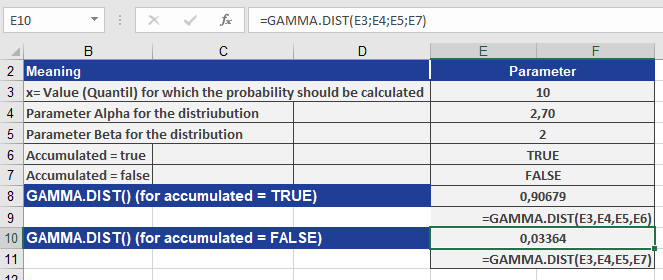
- 0.90679 (cumulative = TRUE)
- 0.03364 (cumulative = FALSE)
Key Takeaways
- The gamma distribution models skewed, positive continuous data.
- Parameters alpha (shape) and beta (scale) define its behavior.
- Cumulative = TRUE returns probabilities (CDF), while FALSE returns density values (PDF).
- Special cases include chi-square, exponential, and Erlang distributions.
This function is essential for advanced statistical modeling, particularly in reliability analysis and stochastic processes.