
This function returns the sum of complex numbers in rectangular form (x + yi or x + yj). It can add between 1 and 255 complex numbers.
Syntax
IMSUM(complex_number1; [complex_number2]; …)
Arguments
- complex_number1 (required)
First complex addend in « x+yi » or « x+yj » format - complex_number2,… (optional)
Additional complex addends (up to 254 more)
Background
The sum of complex numbers is calculated by component-wise addition:
(a + bi) + (c + di) = (a + c) + i·(b + d)
The basics of complex numbers are described in the section titled Functions for Complex Numbers.
Example
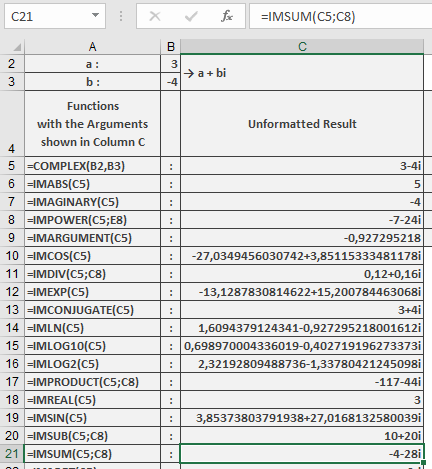
=IMSUM(« 3-4i », »-7-24i ») // Returns « -4-28i »
Additional Examples
=IMSUM(« 1+i », »1-i ») // Returns « 2 » (real number)
=IMSUM(« 2+3i », »4-5i », »6″) // Returns « 12-2i »
=IMSUM(« 3i », »-4i ») // Returns « -i »
Key Features
- Supports 1 to 255 complex arguments
- Maintains 15-digit calculation precision
- Preserves imaginary unit convention from first argument
- Handles mixed « i »/ »j » notation (converts to first argument’s format)
Error Conditions
- Returns #NUM! for:
- Invalid complex number format
- Non-numeric components
- More than 255 arguments
- Returns #VALUE! for incompatible formats