
This function returns the probability of a negatively binomial-distributed random variable. NEGBINOM.DIST() calculates the probability that there will be number_f failures before the number_s-th success occurs, given a constant probability of success probability_s.
Syntax
NEGBINOM.DIST(number_f; number_s; probability_s)
Arguments
- number_f (required): The number of failures
- number_s (required): The number of successes
- probability_s (required): The probability of a success
Background. This function is similar to the binomial distribution, except that the number of successes is fixed and the number of trials is variable. This is known as a negative binomial distribution. As with the binomial distribution, trials are assumed to be independent.
In a random experiment involving independent repetitions with only two possible outcomes (success or failure), the negative binomial distribution (also known as the Pascal distribution) returns the probability of a fixed number of failures before the x-th success. The formula for the negative binomial distribution is:

where:
- x = number_f
- r = number_s
- p = probability_s
Example. You are on vacation in a foreign city and ask a passerby for directions. Each response can only be « yes » or « no », meaning there is a 50% probability that the answer is « yes ». Therefore, p = 0.5.
After asking several people and receiving no helpful answers, you decide to buy a map. Now, you’re interested in knowing the probability of receiving several “No, I’m sorry” responses before encountering five people who can help. You use the NEGBINOM.DIST() function to calculate this probability, as shown in Figure below.
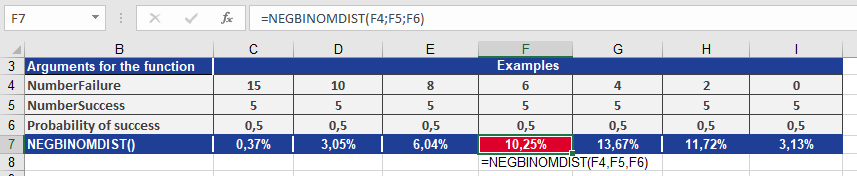
From the result, you can conclude:
With number_f = 6, the probability of asking six people who don’t know the way before you find five people who do is 10.25%.