Its calculates the price of a fixed-interest security with a final interest period that differs in length from previous regular periods, without considering compound interest.
Syntax
ODDLPRICE(Settlement; Maturity; Last_Interest_Date; Rate; Yield; Repayment; Frequency; [Basis])
Arguments
- Settlement (required): Date when ownership of the bond transfers to buyer
- Maturity (required): Date when principal repayment occurs
- Last_Interest_Date (required): Date of last regular interest payment
- Rate (required): Bond’s nominal annual interest rate (coupon rate)
- Yield (required): Market interest rate for bonds of equivalent duration
- Repayment (required): Redemption value as percentage of par value (where par = 100)
- Frequency (required): Interest payments per year (1=annual, 2=semi-annual, 4=quarterly)
- Basis (optional): Day-count convention (see Table 15-2). Defaults to 0 if omitted.
Notes
- Date inputs must not include time values; decimal places are truncated
- Frequency and Basis are converted to integers
- Invalid dates return #NUM! error
- Rate and Yield must be non-negative; otherwise returns #NUM!
- Returns #NUM! if:
- Frequency is not 1, 2, or 4
- Basis is outside 0-4 range
- Chronological order is violated: Maturity > Settlement > Last_Interest_Date
Background
The function applies the financial principle:
Creditor’s Payment = Debtor’s Payment
At transaction initiation:
- Security price + accrued interest = Present value of future cash flows
- Price is expressed as percentage of par value (100 units)
Calculation is straightforward when:
- Settlement coincides with interest payment date, and
- Interest is paid annually
Complexities arise when:
- Settlement occurs between interest dates, or
- Multiple annual payments exist
Common financial methods for partial periods include:
- Moosmüller
- Braess/Fangmeyer
- ISMA (see PRICE() and YIELD() background for Excel-ISMA correlation)
Calculation Method
Excel uses simple yield (no compounding) with these principles:
- Accrued interest calculated from days since last interest payment
- Partial yield derived from days to maturity (based on year length)
- Only applicable during final period before maturity
Example
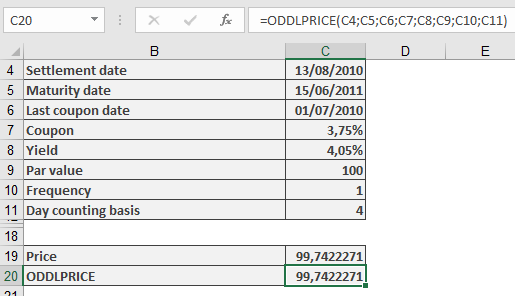
Sample files include a fictitious bond calculation matching the logic, demonstrating:
- Terms with irregular final period
- Price calculation methodology
- Identical results to ODDLPRICE() function output