
Calculates the periodic payment amount (annuity) for a loan or investment based on constant payments and a constant interest rate. For loan repayment calculations, this represents the fixed payment amount that includes both principal and interest.
Syntax
PMT(Rate; Nper; Pv; [Fv]; [Type])
Arguments
| Argument | Requirement | Description |
| Rate | Required | Periodic interest rate (typically annual rate divided by periods per year) |
| Nper | Required | Total number of payment periods |
| Pv | Required | Present value (loan amount or initial investment) |
| [Fv] | Optional | Future value (desired balance after last payment) |
| [Type] | Optional | Payment timing: 0=end of period (default), 1=beginning of period |
Note: Either Pv or Fv must be specified.
Background
The PMT() function is part of a financial function family that includes:
- PV() (present value)
- FV() (future value)
- NPER() (number of periods)
- RATE() (interest rate)
These functions are interrelated through the financial equation:
[Financial equation graphic showing relationship between PV, FV, PMT, NPER, RATE]
Where:
- All values are compounded
- M represents the Type parameter (payment timing)
- The equation is solved for each respective function
Examples
- Annuity Calculation (Retirement Planning)
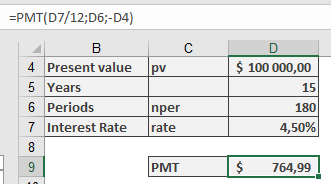
A 60-year-old has $100,000 saved and wants monthly payments for 15 years at 4.5% annual interest.
Scenario A: Exhaust all capital
=PMT(4.5%/12, 15*12, -100000)
Result: $764.99 per month
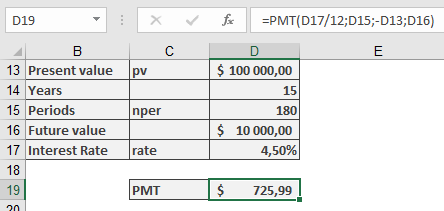
Scenario B: Maintain $10,000 balance
=PMT(4.5%/12, 15*12, -100000, 10000)
Result: $725.99 per month
Note: Negative Pv indicates outgoing payment (capital invested)
- Loan Repayment Calculation
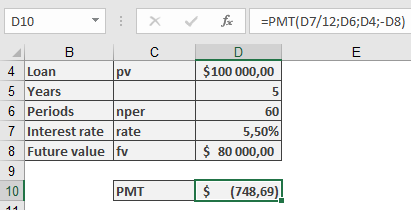
$100,000 loan at 5.5% annual interest with 5-year term and $80,000 residual balance.
=PMT(5.5%/12, 5*12, 100000, -80000)
Result: $748.69 per month (negative indicates outgoing payment)
Key Differences:
- Savings calculations assume compound interest
- Mortgage loans typically use simple monthly interest (annual rate/12)
Important Notes
- For loans, payments are negative (cash outflow)
- Interest rates should match payment periods (annual rate/12 for monthly payments)
- Type parameter significantly affects beginning/end of period calculations
- Results are theoretical for accounts without true compound interest