
Its calculates the maturity value (redemption amount) for a fully discounted security that uses anticipative interest calculation (interest deducted upfront).
Syntax
RECEIVED(Settlement; Maturity; Investment; Discount; [Basis])
Arguments
| Argument | Required | Description | Validation Rules |
| Settlement | Yes | Trade settlement date | Must be valid date ≤ Maturity |
| Maturity | Yes | Security maturity date | Must be valid date ≥ Settlement |
| Investment | Yes | Amount invested (purchase price) | > 0 |
| Discount | Yes | Annual discount rate | > 0 |
| [Basis] | No | Day count convention (0-4) | Default=0 |
Error Conditions
- #VALUE!: Invalid dates or non-numeric inputs
- #NUM!: Negative amounts or invalid Basis
Key Features
- Anticipative Interest Model:
- Interest deducted at inception (discount instrument)
- Contrasts with standard arrears interest calculation
- Common Applications:
- Treasury bills
- Commercial paper
- Bankers’ acceptances
Calculation Method
Maturity Value = Investment / (1 – (Discount × DSM/DIM))
Where:
- DSM = Days from settlement to maturity
- DIM = Days in year per Basis convention
Examples
- Bill of Exchange
Scenario:
- Settlement: 10-May-2010
- Maturity: 10-Jul-2010 (2 months)
- Investment: $4,958.33
- Discount: 5% p.a.
- Basis: 4 (European 30/360)
Calculation:
=RECEIVED(« 5/10/2010″, »7/10/2010 »,4958.33,5%,4)
Result: $5,000.00
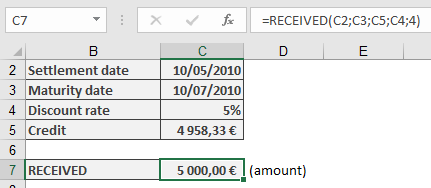
Face value of the bill
Important Notes
- Day Count Conventions:
| Basis | Method |
| 0 | US (NASD) 30/360 |
| 1 | Actual/actual |
| 2 | Actual/360 |
| 3 | Actual/365 |
| 4 | European 30/360 |
- Financial Context:
- Primarily for short-term instruments (<1 year)
- Represents the face value calculation
- Complementary to PRICEDISC() which calculates purchase price
- Implementation Tip:
For precise institutional calculations:
=ROUND(RECEIVED(…), 2)
Related Functions
- PRICEDISC(): Calculates purchase price from face value
- YIELDDISC(): Determines equivalent yield
- INTRATE(): Calculates the interest rate