
Its calculates the depreciation of an asset for a specified period using the sum-of-the-years’ digits (SYD) method, an accelerated depreciation technique that applies higher depreciation expenses in earlier periods.
Syntax
SYD(Cost; Salvage; Life; Per)
Arguments
| Argument | Required | Description | Validation Rules |
| Cost | Yes | Initial asset cost (purchase price + additional expenses – discounts). Must be a positive value. | #VALUE! if non-numeric, invalid if negative. |
| Salvage | Yes | Asset value at the end of its useful life. Must be ≥ 0. | #VALUE! if non-numeric, #NUM! if negative. |
| Life | Yes | Total depreciation periods (integer > 0). | Must be a positive integer. |
| Per | Yes | Specific period for depreciation calculation (integer > 0). | Must be ≤ Life. |
Background
Depreciation reflects the reduction in an asset’s value over time. The SYD method applies a declining depreciation expense each period, unlike straight-line depreciation.
Key Features
- Accelerated Depreciation: Higher expenses in early years, decreasing over time.
- Formula:

-
- Numerator: Remaining useful life at the start of the period.
- Denominator: Sum of the years’ digits (e.g., 5 years → 1+2+3+4+5 = 15).
- Tax & Accounting Use:
- Permitted in some jurisdictions for tax benefits.
- Not suitable for all assets (check local regulations).
Example
Asset Details:
- Cost: $1,000
- Salvage Value: $0
- Life: 5 years
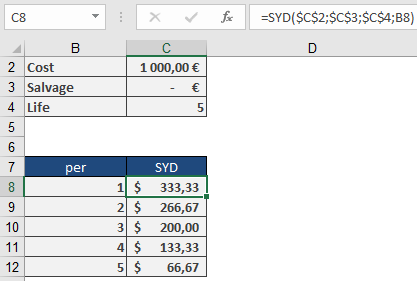
Depreciation Schedule:
| Year | Calculation (SYD) | Depreciation | Book Value |
| 1 | =SYD(1000,0,5,1) | $333.33 | $666.67 |
| 2 | =SYD(1000,0,5,2) | $266.67 | $400.00 |
| 3 | =SYD(1000,0,5,3) | $200.00 | $200.00 |
| 4 | =SYD(1000,0,5,4) | $133.33 | $66.67 |
| 5 | =SYD(1000,0,5,5) | $66.67 | $0.00 |
Key Takeaway:
- Year 1 has the highest depreciation ($333.33).
- Year 5 has the lowest ($66.67).
Implementation Notes
- Partial-Year Depreciation:
- SYD assumes full periods. Adjust manually for mid-year purchases.
- Complementary Functions:
- SLN(): Straight-line depreciation.
- DDB(): Double-declining balance (more aggressive than SYD).
- Best Practices:
- Use ROUND(SYD(…), 2) for financial reporting precision.
- Verify tax compliance before applying SYD.