
Its Calculates the bond-equivalent yield (annualized return) for a U.S. Treasury bill (T-bill) based on its discount rate, converting the T-bill’s discount yield (360-day basis) to an equivalent investment yield (365-day basis).
Syntax
TBILLEQ(Settlement; Maturity; Discount)
Arguments
| Argument | Required | Description | Validation Rules |
| Settlement | Yes | Trade date (when T-bill is purchased). | Must be a valid date < Maturity. |
| Maturity | Yes | Maturity date (when T-bill is redeemed). | Must be ≤ 1 year after Settlement. |
| Discount | Yes | Discount rate (as a decimal, e.g., 5% = 0.05). | Must be > 0. |
Error Conditions
- #VALUE!: Invalid dates.
- #NUM!: If:
- Settlement ≥ Maturity
- Maturity > 1 year after Settlement
- Discount ≤ 0
Background
T-bills are zero-coupon securities sold at a discount and redeemed at par. The TBILLEQ function converts the discount rate (used to price T-bills) into an equivalent annual yield (used to compare returns with other investments).
Key Formula

Where:
- Days = Actual days between Settlement and Maturity.
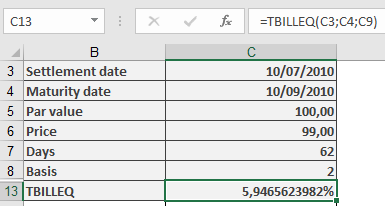
Example
Key Notes
- Comparison with Other Functions
- YIELDDISC(): Returns the yield directly (no 365-day conversion).
- RECEIVED(): Calculates maturity value, not yield.
- Practical Use
- Compare T-bill returns with bonds or savings accounts.
- Adjusts for the 360-day banking year used in T-bill pricing.
- Limitations
- Only valid for T-bills with maturities ≤ 1 year.
- Does not account for compounding.