
This function returns values of a Weibull-distributed random variable. It is typically used in reliability analysis, such as calculating the mean time to failure of a device.
Syntax. WEIBULL.DIST(x; alpha; beta; cumulative)
Arguments
- x (required): The value at which the function is to be evaluated.
- alpha (required): A shape parameter of the distribution.
- beta (required): A scale parameter of the distribution.
- cumulative (required): A logical value that specifies the form of the function:
— If TRUE, WEIBULL.DIST() returns the cumulative distribution function (CDF)—i.e., the probability that the event occurs between 0 and x.
— If FALSE, the function returns the probability density function (PDF)—i.e., the value of the density function at x.
Background
The Weibull distribution is a statistical distribution widely used to model life expectancy and failure rates, especially for brittle materials or electronic components.
Named after Waloddi Weibull (1887–1979), this distribution is a cornerstone in reliability engineering and is commonly visualized using a Weibull plot—often called a Weibull net—which represents life cycles and failure probabilities of mechanical or electronic parts. It is frequently used in the automotive industry.
In essence, the Weibull distribution can represent various types of data depending on its parameters. It is flexible, mathematically simple to calculate, and can model:
- Early-life failures (infant mortality),
- Random failures (constant failure rate),
- Wear-out failures (increasing failure rate).
Key properties:
- The distribution function (CDF) indicates the probability that a random variable y is less than or equal to x.
- The density function (PDF) is the derivative of the distribution function with respect to x, representing the failure rate at a specific point in time.
To calculate:
- The density function, set cumulative = FALSE.
- The distribution function, set cumulative = TRUE.
Formulas
- Cumulative Distribution Function (CDF):

- Density Function (PDF):
The first derivative of the distribution function with respect to x.
Note: If α = 1, WEIBULL.DIST() becomes an exponential distribution.
- Failure rate behavior depends on α:
- If α < 1, failure rate decreases over time (early failures).
- If α = 1, failure rate is constant (random failures).
- If α > 1, failure rate increases over time (wear-out failures).
Example
Let’s compute values using WEIBULL.DIST() with the following parameters:
- x = 105 (value to evaluate)
- alpha = 20
- beta = 100
- cumulative = TRUE / FALSE
As shown in Figure below, the function returns:
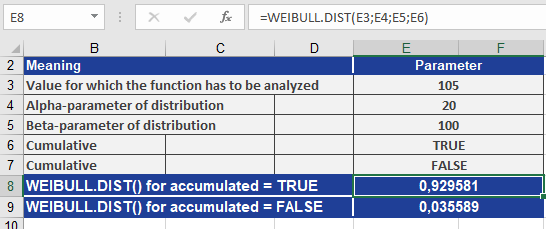
- For cumulative = TRUE: 0.929581 (CDF – cumulative probability up to 105)
- For cumulative = FALSE: 0.035589 (PDF – probability density at 105)