Votre panier est actuellement vide !
Étiquette : excel_vba
Starting the Vocabulary Test in Excel VBA
In Module1, you will find the procedure
VocabularyTest(). It contains the entire test workflow: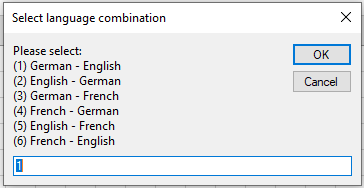
Vocabulary Test Procedure (English version)
Sub VocabularyTest()
    ' Define variables
    Dim UserInput As String
    Dim LanguageCombo As Integer
    Dim Language1 As String
    Dim Language2 As String
    Dim Vocab1 As New Collection
    Dim Vocab2 As New Collection
    Dim RowIndex As Integer, Col1 As Integer, Col2 As Integer
    Dim RandomIndex As Integer
    Dim Feedback As String
    Dim PromptText As String
    Dim TestEnd As Boolean
    ' Select language combination
    Do
        UserInput = InputBox( _
            "Please select:" & vbCrLf & _
            "(1) German - English" & vbCrLf & _
            "(2) English - German" & vbCrLf & _
            "(3) German - French" & vbCrLf & _
            "(4) French - German" & vbCrLf & _
            "(5) English - French" & vbCrLf & _
            "(6) French - English", _
            "Select language combination", 1)
        If IsNumeric(UserInput) Then
            LanguageCombo = Val(UserInput)
        Else
            LanguageCombo = 0
        End If
    Loop Until LanguageCombo >= 1 And LanguageCombo <= 6
    ' Set source and target languages based on selection
    Select Case LanguageCombo
        Case 1
            Language1 = "German"
            Language2 = "English"
            Col1 = 1
            Col2 = 2
        Case 2
            Language1 = "English"
            Language2 = "German"
            Col1 = 2
            Col2 = 1
        Case 3
            Language1 = "German"
            Language2 = "French"
            Col1 = 1
            Col2 = 3
        Case 4
            Language1 = "French"
            Language2 = "German"
            Col1 = 3
            Col2 = 1
        Case 5
            Language1 = "English"
            Language2 = "French"
            Col1 = 2
            Col2 = 3
        Case 6
            Language1 = "French"
            Language2 = "English"
            Col1 = 3
            Col2 = 2
    End Select
    ' Initialization
    ThisWorkbook.Worksheets("Sheet2").Activate
    TestEnd = False
    Feedback = ""
    ' Load vocabulary into collections
    RowIndex = 2
    Do While Cells(RowIndex, Col1).Value <> ""
        Vocab1.Add Cells(RowIndex, Col1).Value
        Vocab2.Add Cells(RowIndex, Col2).Value
        RowIndex = RowIndex + 1
    Loop
    ThisWorkbook.Worksheets("Sheet1").Activate
    ' Begin test loop
    Do
        ' Get random index within collection size
        RandomIndex = WorksheetFunction.RoundUp(Rnd * Vocab1.Count, 0)
        ' Prepare previous question's feedback
        If Feedback <> "" Then
            PromptText = Feedback & vbCrLf
        Else
            PromptText = ""
        End If
        ' Compose question text
        PromptText = PromptText & _
            "Remaining " & Vocab1.Count & " vocabulary items " & _
            "(Abort with '0')" & vbCrLf & vbCrLf & _
            Language1 & ": " & Vocab1(RandomIndex) & vbCrLf & _
            Language2 & ": "
        UserInput = InputBox(PromptText, "Enter your answer")
        ' Evaluate response
        If UserInput = Vocab2(RandomIndex) Then
            Feedback = "Correct"
            Vocab1.Remove RandomIndex
            Vocab2.Remove RandomIndex
            ' Test complete if no vocabulary left
            If Vocab1.Count < 1 Then
                MsgBox "Test successfully completed"
                TestEnd = True
            End If
        ElseIf UserInput = "0" Then
            MsgBox "Test aborted"
            TestEnd = True
        Else
            Feedback = "Incorrect. The correct answer is: " & Vocab2(RandomIndex)
        End If
    Loop Until TestEnd
End Sub
Explanation of Variables and Workflow (English)
- UserInput: Stores the user’s input string.
- LanguageCombo: Stores the selected language combination number (1 to 6).
- Language1 and Language2: StorQSSDe the names of the source and target languages, respectively.
- Vocab1 and Vocab2: Collections that hold vocabulary words from the chosen source and target languages. When a correct answer is given, the corresponding pair is removed from both collections. The test ends when both are empty.
- RowIndex, Col1, and Col2: Used to read vocabulary from the second worksheet.
- RandomIndex: Stores a randomly generated index to select the current vocabulary pair.
- Feedback: Stores feedback such as « Correct » or « Incorrect… » messages.
- PromptText: Holds the complete prompt text shown in the input box, including any previous feedback.
- TestEnd: Boolean flag to indicate when the test ends (either success or abort).
Workflow:
- The user is repeatedly prompted to select a language combination until they enter a valid number between 1 and 6.
- Based on the selection, source and target language names and their corresponding column numbers in the vocabulary worksheet are set.
- The vocabulary worksheet (« Sheet2 ») is activated, and vocabulary pairs are loaded into two collections by reading rows until an empty cell is found.
- The main worksheet (« Sheet1 ») is reactivated to prevent the user from seeing the vocabulary list.
- The test loop starts:
- A random vocabulary pair is selected.
- Any previous feedback is added to the question prompt.
- The user is asked to translate the displayed word.
- If the answer is correct, the pair is removed.
- If no vocabulary remains, a success message is displayed and the test ends.
- If the user enters « 0 », the test aborts.
- If incorrect, feedback is shown and the question will be asked again later.
Vocabulary Collection Setup in Excel VBA
The vocabulary list is located on the second worksheet. The user can view the vocabulary for study purposes and may freely extend, modify, or shorten the list, provided that the structure of the list is maintained.
Structure of the List:
- The first row contains the headers.
- The rows below contain the vocabulary entries.
- The user can control the length of the test by inserting a blank row.
- During a test, only the vocabulary entries up to the first blank row are included.
In the class module ThisWorkbook, you will find the procedure Workbook_Open():
Private Sub Workbook_Open()
    ThisWorkbook.Worksheets("Sheet1").Activate
End Sub
This procedure ensures that after opening the file, the user always sees the worksheet with the Start button for the vocabulary test, preventing accidental viewing of the vocabulary collection.
Starting the Snake Game in Excel VBA
In Module1, you will find two module-wide variables and the procedure Start(). These are used to initialize the game and manage the game state.

Variables:
Public Direction As Integer
Dim Started As Boolean
Explanation:
- The variable Direction is declared with workbook-wide scope because it is accessed by multiple procedures across modules or multiple calls to the same procedure.
- The Boolean variable Started is scoped to this module and prevents the game from being started more than once if it is already running.
- Direction holds the snake’s current movement direction as an integer value.
Procedure
Start():Sub Start() Dim StartTime As Single Dim WaitTime As Single Dim RowSnake As Integer, ColSnake As Integer ' Snake position (row, column) Dim RowPrey As Integer, ColPrey As Integer ' Prey position (row, column) Dim GameOver As Boolean ' Prevent multiple starts If Started Then Exit Sub Started = True ' Clear game board colors Range("B2:K11").Interior.Color = xlNone ' Reset score counter Range("N8").Value = 0 ' Initial wait time between moves (in seconds) WaitTime = 0.5 ' Game not over yet GameOver = False ' Set snake start position and color RowSnake = 10 ColSnake = 6 Cells(RowSnake, ColSnake).Interior.Color = vbGreen ' Initial movement direction: up (0) Direction = 0 ' Set prey start position and color RowPrey = 3 ColPrey = 9 Cells(RowPrey, ColPrey).Interior.Color = vbRed ' Initialize random number generator Randomize ' Main game loop runs until collision ends the game Do While Not GameOver ' Start timer for delay StartTime = Timer ' Wait for the duration of WaitTime Do While Timer < StartTime + WaitTime DoEvents ' Allow user interaction during wait Loop ' Clear old snake cell color Cells(RowSnake, ColSnake).Interior.Color = xlNone ' Move snake according to direction If Direction = 0 Then ' Up If RowSnake >= 3 Then RowSnake = RowSnake - 1 Else GameOver = True End If ElseIf Direction = 1 Then ' Right If ColSnake <= 10 Then ColSnake = ColSnake + 1 Else GameOver = True End If ElseIf Direction = 2 Then ' Down If RowSnake <= 10 Then RowSnake = RowSnake + 1 Else GameOver = True End If Else ' Left (3) If ColSnake >= 3 Then ColSnake = ColSnake - 1 Else GameOver = True End If End If ' Color new snake cell Cells(RowSnake, ColSnake).Interior.Color = vbGreen ' Check if snake "eats" the prey If RowSnake = RowPrey And ColSnake = ColPrey Then ' Increase score by 1 Range("N8").Value = Range("N8").Value + 1 ' Set prey to new random position RowPrey = Int(Rnd * 10 + 2) ColPrey = Int(Rnd * 10 + 2) Cells(RowPrey, ColPrey).Interior.Color = vbRed ' Decrease wait time by 10% to speed up snake WaitTime = WaitTime * 0.9 End If Loop ' Game over message MsgBox "End of the game", , "Game Over" ' Reset started flag for next game Started = False End SubDetailed Explanation:
- StartTime and WaitTime control a timing loop to manage the delay between snake movements. StartTime records the current time when the loop starts, and WaitTime determines how long to wait before the snake moves again. This wait time decreases after each prey eaten, making the snake move faster.
- RowSnake and ColSnake represent the current row and column of the snake on the board. RowPrey and ColPrey represent the row and column of the prey.
- The Boolean GameOver flags the end of the game when set to True, such as when the snake collides with the board boundary.
- The Boolean Started prevents multiple game starts.
- Upon the first start, the game board’s interior cells are cleared of any color, the counter reset to 0, and the snake and prey placed at initial “safe” positions (snake colored green, prey colored red).
- The snake initially moves upward (Direction = 0).
- The Randomize statement prepares the random number generator to position the prey randomly.
- The main game loop runs until GameOver becomes True. Inside this loop, a timer-based delay lets the user interact, changing the snake’s direction if desired.
- After waiting, the snake’s old cell is cleared, and a new position is calculated based on the current direction.
- If the snake reaches the prey’s position, the counter increments, the prey moves randomly, and the snake’s speed increases.
- When the snake hits the boundary, the game ends with a message box.
- Finally, the Started flag resets to allow restarting.
Controlling the Snake Game in Excel VBA
In the class module for Sheet1, you will find the procedure Worksheet_SelectionChange(). This procedure is responsible for handling user input during the game.
Private Sub Worksheet_SelectionChange(ByVal Target As Range)
    If Target.Address = "$M$2:$O$2" Then
        Starten
    ElseIf Target.Address = "$M$11:$O$11" Then
        MsgBox "The green snake must eat the red prey to earn points." & vbCrLf & _
               "After eating, the snake speeds up." & vbCrLf & _
               "You can steer the snake, but you cannot immediately reverse its direction." & vbCrLf & _
               "The game ends when the snake hits the wall.", , "Game Instructions"
    ElseIf Target.Address = "$N$4" Then
        If Richtung <> 2 Then Richtung = 0
    ElseIf Target.Address = "$O$5" Then
        If Richtung <> 3 Then Richtung = 1
    ElseIf Target.Address = "$N$6" Then
        If Richtung <> 0 Then Richtung = 2
    ElseIf Target.Address = "$M$5" Then
        If Richtung <> 1 Then Richtung = 3
    End If
    ' Reactivate center cell to ensure SelectionChange event fires next time
    Range("N5").Activate
End Sub
Explanation:
- The Worksheet_SelectionChange() event is triggered whenever the user selects a new cell.
- The selected cell or merged range is passed as the Target object. Its .Address property returns the address as a string.
- If the START button cells (address $M$2:$O$2) are selected, the Starten procedure in Module1 is called to start the game.
- If the INFO button cells (address $M$11:$O$11) are selected, a message box displays the game instructions.
- The four cells N4, O5, N6, and M5 correspond to controls for changing the snake’s movement direction:
- N4 sets direction up (0), unless the current direction is down (2), which would be an immediate reversal and is disallowed.
- O5 sets direction right (1), unless the current direction is left (3).
- N6 sets direction down (2), unless current direction is up (0).
- M5 sets direction left (3), unless current direction is right (1).
- The directions 0, 1, 2, 3 correspond to up, right, down, and left, respectively — arranged clockwise.
- Finally, the cell N5 (center of the four direction controls) is reactivated. This is important because the SelectionChange event only fires when the active cell changes. Without this step, clicking the same directional cell repeatedly would not trigger the event.
Snake Game Board Setup in Excel VBA
In the class module ThisWorkbook, you will find the procedure Workbook_Open(). This procedure sets up the game board immediately after opening the file.
Private Sub Workbook_Open()
    ThisWorkbook.Worksheets("Sheet1").Activate
    Cells.Delete
    Cells.RowHeight = 20
    Cells.ColumnWidth = 3.5
    ' Borders for the game board
    Range("B2:K2").Borders(xlEdgeTop).Weight = xlThick
    Range("B11:K11").Borders(xlEdgeBottom).Weight = xlThick
    Range("B2:B11").Borders(xlEdgeLeft).Weight = xlThick
    Range("K2:K11").Borders(xlEdgeRight).Weight = xlThick
    ' Start button cell
    Range("M2").Value = "Start"
    With Range("M2:O2")
        .Interior.Color = RGB(192, 192, 192)
        .MergeCells = True
        .HorizontalAlignment = xlCenter
        .VerticalAlignment = xlCenter
    End With
    ' Direction control cells with neutral cell in the center
    Range("N4, M5, O5, N6").Interior.Color = RGB(192, 192, 192)
    Range("N5").Activate
    ' Counter cell
    Range("N8").Value = 0
    With Range("N8")
        .Interior.Color = vbYellow
        .HorizontalAlignment = xlCenter
        .VerticalAlignment = xlCenter
    End With
    ' Info button cell
    Range("M11").Value = "Info"
    With Range("M11:O11")
        .Interior.Color = RGB(192, 192, 192)
        .MergeCells = True
        .HorizontalAlignment = xlCenter
        .VerticalAlignment = xlCenter
    End With
End Sub
Explanation:
- The worksheet Sheet1 is activated.
- Using the Delete method on all Cells, the sheet is cleared.
- The row height and column width of all cells are set to create square-shaped cells (row height = 20, column width = 3.5).
- The game board is defined by the range B2:K11, and thick borders are applied around its edges. This border defines the game boundary the snake must not collide with.
- The cells for the START button (range M2:O2) are merged into one large cell, filled with a gray background color, and text is centered horizontally and vertically.
- Similarly, the INFO button cells (M11:O11) are merged and formatted the same way.
- The four cells used to control the snake’s movement direction (N4, M5, O5, N6) are shaded gray.
- The cell N5 in the center of these direction controls is activated. This activation happens after every click to ensure the SelectionChange event fires on the next click; otherwise, clicking the same cell twice would not trigger the event.
- The counter cell (N8) is initialized to zero and colored yellow, with centered text both horizontally and vertically.
Operating the Game in Excel VBA
In the class module for Sheet1, you will find two module-level variables and the procedure Worksheet_SelectionChange(). These are used to handle user interaction with the game.
Dim row1 As Integer, col1 As Integer
Private Sub Worksheet_SelectionChange(ByVal Target As Range)
    Dim row As Integer, col As Integer
    Dim startTime As Single
    ' Start and Info buttons
    If Target.Address = "$I$2:$K$2" Then
        StartGame
    ElseIf Target.Address = "$I$7:$K$7" Then
        MsgBox "Find 18 pairs of symbols." & vbCrLf & _
               "Select two cells one after another." & vbCrLf & _
               "You will see the symbol in each cell." & vbCrLf & _
               "One second after selecting the 2nd cell, both symbols are covered again.", , "Game Description"
    ' Memory game cells
    Else
        ' Determine row and column numbers from the cell address
        row = Val(Mid(Target.Address, 4, 1))
        col = Asc(Mid(Target.Address, 2, 1)) - 64
        ' If outside the game board, exit
        If row < 2 Or row > 7 Or col < 2 Or col > 7 Then Exit Sub
        ' If the symbol is already found (empty), exit
        If Symbols(row, col) = "" Then Exit Sub
        ' Second symbol selection
        If FirstSymbolVisible Then
            FirstSymbolVisible = False
            ' Show second symbol
            Cells(row, col).Value = Symbols(row, col)
            Cells(row, col).Interior.Color = xlNone
            ' Wait one second
            startTime = Timer
            Do While Timer < startTime + 1
                DoEvents
            Loop
            ' Clear both cells
            Cells(row, col).Value = ""
            Cells(row1, col1).Value = ""
            ' Check if pair found
            If Symbols(row, col) = Symbols(row1, col1) Then
                ' Remove pair from the game visually
                Cells(row, col).Interior.Color = xlNone
                Cells(row1, col1).Interior.Color = xlNone
                Symbols(row, col) = ""
                Symbols(row1, col1) = ""
                ' Increase found count
                PairsFound = PairsFound + 1
                ' Check for game end
                If PairsFound = 18 Then
                    GameStarted = False
                    MsgBox "Game Over", , "End"
                End If
            Else
                ' Hide symbols again by coloring gray
                Cells(row, col).Interior.Color = RGB(192, 192, 192)
                Cells(row1, col1).Interior.Color = RGB(192, 192, 192)
            End If
        ' First symbol selection
        Else
            FirstSymbolVisible = True
            Cells(row, col).Value = Symbols(row, col)
            Cells(row, col).Interior.Color = xlNone
            row1 = row
            col1 = col
        End If
    End If
End Sub
Explanation:
- The module-level variables z1 and s1 store the row and column numbers of the first selected cell.
- The event procedure Worksheet_SelectionChange() is triggered whenever the user clicks a new cell. Variables z and s extract the row and column numbers from the clicked cell’s address.
- The variable Startzeit stores the time at which a waiting loop starts.
- The Target object represents the selected range. Its .Address property returns the address string of the clicked cell or merged cell range.
- If the user clicks the START button cell (address $I$2:$K$2), the Starten procedure is called to initialize the game.
- If the user clicks the INFO button cell (address $I$7:$K$7), a message box with the game instructions is displayed.
- For other clicked cells, the row (z) and column (s) are determined by extracting parts of the address string with the functions Mid(), Val(), and Asc().
- Mid() extracts substrings.
- Val() converts a string to an integer.
- Asc() returns the ASCII code of a character; subtracting 64 converts column letters (A=1, B=2, etc.) to numeric indices.
- If the clicked cell lies outside the game board (rows or columns outside 2 to 7), the procedure exits immediately.
- If the symbol at the clicked cell has already been found (empty string), the procedure also exits. This enforces synchronization between the symbol array and the worksheet cells.
- The procedure distinguishes whether the clicked cell is the first or second in a pair selection by checking the Boolean ErstesZeichenSichtbar.
- When the second cell is selected:
- The second symbol is shown.
- The code waits for one second (using a loop checking the system timer).
- Then, both cells are cleared.
- If the symbols match, both cells are visually removed (background cleared), the symbol array entries cleared, and the count of found pairs incremented.
- If all 18 pairs are found, the game ends, and the Gestartet flag is reset so a new game can be started.
- If no match, both cells are covered again with the gray background.
- When the first cell is selected:
- Its symbol is revealed and background cleared.
- The row and column indices are saved for later comparison.
Enjoy playing the game, exploring the code, and programming your own extensions! For example, instead of 18 pairs with no background color, you could use 6 pairs with 3 different background colors. Then the player must remember not only the symbol but also the background color it appeared on.
Starting the Game in Excel VBA
In Module1, you will find several variables and an array declared with workbook-wide scope, along with the procedure Starten(). These serve to initialize the game and control its state.
Variables:
Public Symbols(2 To 7, 2 To 7) As String
Public Started As Boolean
Public FirstSymbolVisible As Boolean
Public Found As Integer
Explanation:
- These variables and the array are declared at the module (workbook) level because they need to be accessed by multiple procedures in different modules or different calls of the same procedure.
- The two-dimensional array Zeichen has 6 rows and 6 columns (indices 2 to 7 for both dimensions). It holds the 18 pairs of matching symbols distributed randomly on the game board.
- The Boolean variable Gestartet prevents the game from being started more than once if it is already running.
- The Boolean variable ErstesZeichenSichtbar indicates whether the first symbol is currently visible. This helps determine if the user has just clicked the first or the second cell.
- The Integer variable Gefunden counts how many pairs have been found so far. When it reaches 18, the game is over.
The procedure Starten():
' Global variables
Dim Symbols(1 To 8, 1 To 8) As String
Dim Started As Boolean
Dim FirstSymbolVisible As Boolean
Dim Found As Integer
Sub StartGame()
    Dim row As Integer, col As Integer
    Dim i As Integer
    ' Variables for shuffling
    Dim row1 As Integer, col1 As Integer
    Dim row2 As Integer, col2 As Integer
    Dim temp As String
    ' Prevent restarting if already started
    If Started Then Exit Sub
    Started = True
    ' Fill array with pairs of characters (A to R, each appears twice)
    row = 2
    col = 2
    For i = 1 To 18
        Symbols(row, col) = Chr(i + 64)         ' ASCII code for letters A to R
        Symbols(row, col + 1) = Chr(i + 64)
        col = col + 2
        If col > 7 Then
            row = row + 1
            col = 2
        End If
    Next i
    ' Initialize random number generator
    Randomize
    ' Shuffle array elements by swapping pairs 180 times
    For i = 1 To 180
        row1 = Int(Rnd * 6 + 2)
        col1 = Int(Rnd * 6 + 2)
        row2 = Int(Rnd * 6 + 2)
        col2 = Int(Rnd * 6 + 2)
        temp = Symbols(row1, col1)
        Symbols(row1, col1) = Symbols(row2, col2)
        Symbols(row2, col2) = temp
    Next i
    ' Cover all game board cells and fill with gray background
    For row = 2 To 7
        For col = 2 To 7
            Cells(row, col).Value = ""
            Cells(row, col).Interior.Color = RGB(192, 192, 192)
        Next col
    Next row
    ' Set initial states
    FirstSymbolVisible = False
    Found = 0
End Sub
Explanation:
- The integer variables z, s, and i are used for filling the two-dimensional array.
- The variables z1, s1, z2, and s2 plus the string variable Tausch are used for swapping elements during the shuffle.
- The Boolean variable Gestartet is checked to prevent restarting the game if it is already running; if it’s the first start, it is set to True.
- The array is filled row-wise: first two elements with the letter « A » (ASCII 65), then two elements with « B » (ASCII 66), and so on. After placing three pairs in one row, it moves to the next row.
- The Randomize statement initializes the random number generator.
- The shuffle process swaps pairs of elements 180 times at random positions to thoroughly mix the array contents.
- All cells of the game board are cleared and filled with a gray background color.
- Initial values are set: no symbol is visible yet, and the number of found pairs is zero.
Game Board Setup in Excel VBA
In the class module ThisWorkbook, you will find the procedure Workbook_Open(). This procedure initializes the game board right after the workbook is opened:
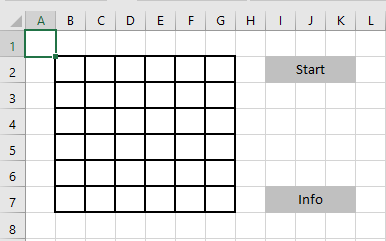
Private Sub Workbook_Open()
    ' Clear all cells and set them to square shape
    ThisWorkbook.Worksheets("Sheet1").Activate
    Cells.Delete
    Cells.RowHeight = 20
    Cells.ColumnWidth = 3.5
    ' Add borders and formatting to the game board area
    With Range("B2:G7")
        .Borders.Weight = xlMedium
        .HorizontalAlignment = xlCenter
        .VerticalAlignment = xlCenter
        .Font.Size = 14
    End With
    ' Setup START button cell
    Range("I2").Value = "Start"
    With Range("I2:K2")
        .Interior.Color = RGB(192, 192, 192)
        .MergeCells = True
        .HorizontalAlignment = xlCenter
        .VerticalAlignment = xlCenter
    End With
    ' Setup INFO button cell
    Range("I7").Value = "Info"
    With Range("I7:K7")
        .Interior.Color = RGB(192, 192, 192)
        .MergeCells = True
        .HorizontalAlignment = xlCenter
        .VerticalAlignment = xlCenter
    End With
End Sub
Explanation:
- The worksheet Sheet1 is first activated.
- Using the Delete method on Cells, all cell contents are cleared.
- The row height and column width of all cells are set to create square-shaped cells (row height = 20, column width = 3.5).
- The game board area, defined as the range from B2 to G7, is formatted with medium-weight borders. Cell content is centered horizontally and vertically, and the font size is set to 14.
- The cells for the START button (range I2:K2) are merged into one large cell, filled with a gray background color, and the text is horizontally and vertically centered.
- The same setup is applied for the INFO button in cells I7:K7.
RefEdit and Toggle Button in Excel VBA
The RefEdit control is used to allow the user to select a cell range from a worksheet. It works similarly to the Application.InputBox() function with the Type parameter set to request a range, but unlike the InputBox, RefEdit is embedded in a UserForm and combined with other controls.
Cell ranges can be entered either by typing directly into the RefEdit box or by selecting the range with the mouse.
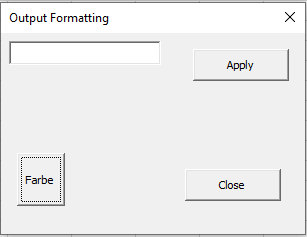
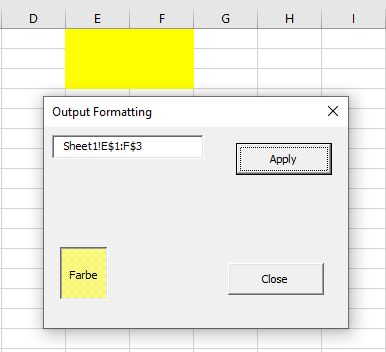
Mouse selection is only possible if the cursor is first inside the RefEdit control, as shown in Figure 10.20. After clicking on the worksheet to select a range, the entire dialog box shrinks so that only the RefEdit control remains visible, as illustrated in Figure.

A toggle button is used to switch between or display two possible states. Its most important property is Value, which can be either True or False.
In the following example from the UserForm module frmRefEdit, both controls are used to either highlight or clear the fill color of the selected cell range, as shown in Figure.
Program code:
Private Sub tglFarbe_Click()
    If tglFarbe.Value Then
        tglFarbe.BackColor = vbYellow
    Else
        tglFarbe.BackColor = vbWhite
    End If
End Sub
Private Sub cmdUebertragen_Click()
    On Error GoTo Fehler
    If tglFarbe.Value Then
        Range(rfeZellbereich.Value).Interior.Color = vbYellow
    Else
        Range(rfeZellbereich.Value).Interior.Pattern = xlNone
    End If
    Exit Sub
Fehler:
    MsgBox "No range was selected"
End Sub
Private Sub cmdEnde_Click()
    Unload Me
End Sub
Explanation:
- Clicking the toggle button switches its Value property between True and False. To make the state visually clearer, the toggle button’s background color also changes accordingly: yellow when active (pressed) and white when inactive.
- Clicking the TRANSFER command button applies the yellow fill color to the selected cell range if the toggle button is on, or clears the fill pattern if it is off.
- Since the user can enter text that does not represent a valid cell range into the RefEdit control, error handling with On Error is used to catch such cases and display a message box informing the user that no valid range was selected.
Output Formatting in Excel VBA
When outputting to controls within custom dialog boxes, this function offers additional benefits.
Below is a dialog box example from the UserForm module frmAusgabeformat where a small table is displayed both in a list box and in a label control.
For both controls, the Font property is initially set to Courier New. This is a monospaced font, meaning each character occupies the same width. This uniform spacing is important for tabular formatting.
Additionally, the label control’s SpecialEffect property is set to 2 (fmSpecialEffectSunken), which creates a slightly sunken (3D) appearance to make the label visually distinct.
Application code:
Private Sub UserForm_Initialize()
    Dim ID(1 To 3) As Integer
    Dim Product(1 To 3) As String
    Dim Price(1 To 3) As Single
    Dim Line As String
    Dim i As Integer
    ' Initialize arrays
    ID(1) = 5
    ID(2) = 11
    ID(3) = 346
    Product(1) = "Apple"
    Product(2) = "Banana"
    Product(3) = "Potato"
    Price(1) = 2
    Price(2) = 1.95
    Price(3) = 2.5
    For i = 1 To 3
        ' Compose formatted output line
        Line = Format(ID(i), "@@@@") & " " & _
               Format(Product(i), "!@@@@@@@@@@@@") & _
               Format(Format(Price(i), "0.00 €"), "@@@@@@@")

        ' Add line to list box and label caption
        lstTable.AddItem Line
        lblTable.Caption = lblTable.Caption & Line & vbCrLf
    Next i
End Sub
Result:
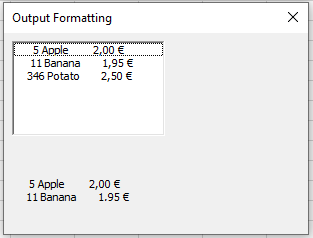
Explanation:
First, three arrays of types Integer, String, and Single are declared and populated with values.
The corresponding elements from these arrays are concatenated into a formatted string.
This string is added both to the list box and to the label control.
- The formatting string @@@@ ensures the integer number is output right-aligned with a fixed width of 4 characters (@ represents one character placeholder).
- Using the exclamation mark ! causes left-aligned output. In this case, the formatting string !@@@@@@@@@@@@ outputs the string left-aligned with a fixed width of 12 characters.
- A nested use of the Format() function is applied for the price: the inner format « 0.00 € » converts the number into a string with two decimal places followed by the euro symbol.
- The outer Format() ensures this string is right-aligned with a fixed width of 7 characters using the format string @@@@@@@.